
Vectorless RAG: Can We Build RAG Without a Vector Database?
A practical guide to document trees, PageIndex, LLM-generated Wikis, hybrid retrieval, and choosing the right RAG architecture.
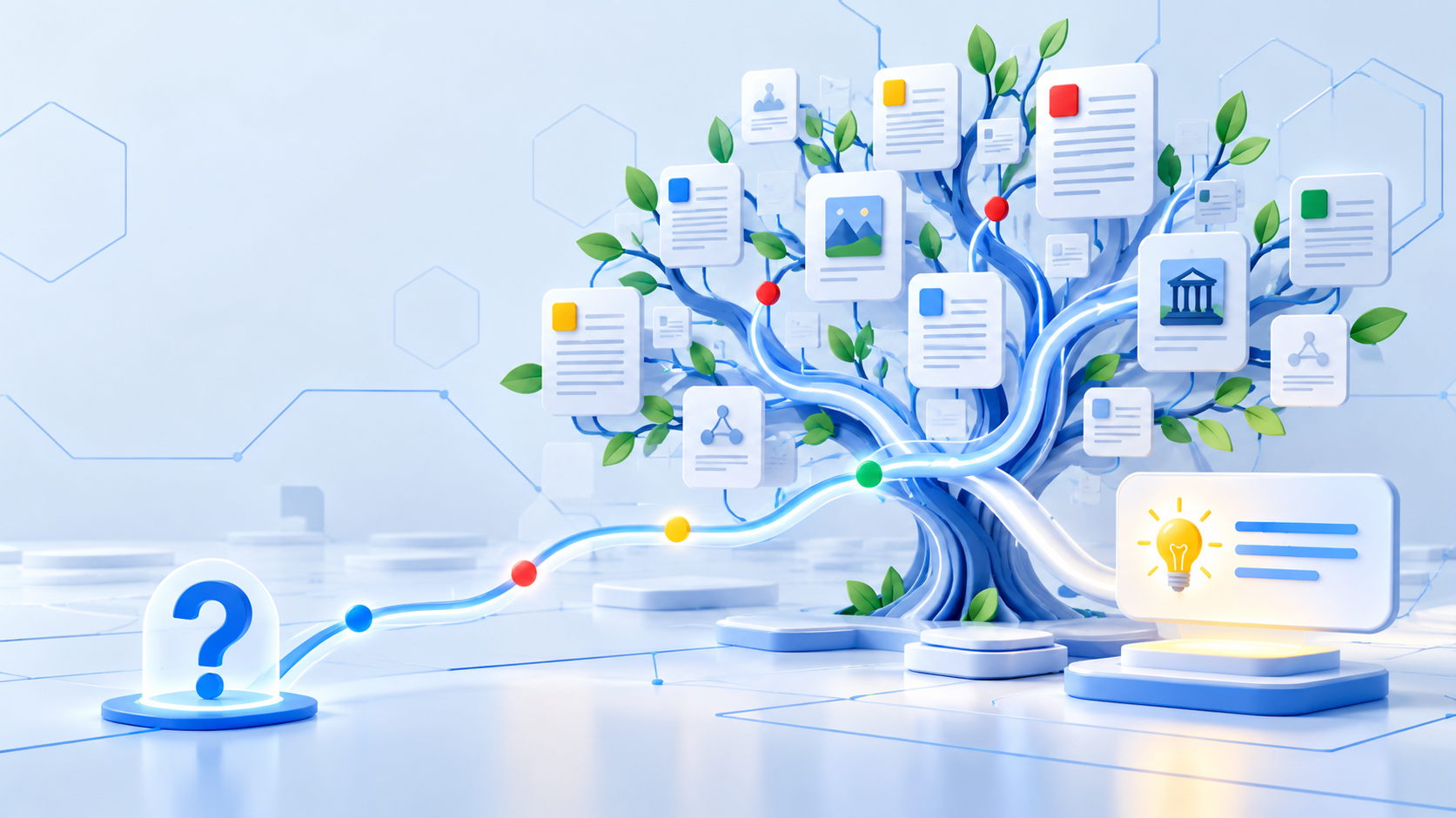
Vector databases are one way to retrieve context for a language model. They are useful, widely adopted, and often a good default. They are not the definition of retrieval-augmented generation (RAG), though. RAG needs a way to find relevant evidence and provide it to a generator; that retrieval step can use vector similarity, lexical search, document structure, a knowledge graph, an LLM-generated Wiki, or a combination.
That opens an interesting question: Can we build RAG without a vector database? Yes. For some workloads, an LLM can navigate a structured document index or a curated knowledge layer and retrieve evidence without embedding every chunk. This family of designs is often called vectorless RAG. The name is useful shorthand, not a strict standard: implementations differ, and “vectorless” does not necessarily mean there is no index or search at all.
In brief: Vector RAG ranks embedded passages by semantic similarity. Vectorless approaches can navigate document structure or retrieve from a compiled knowledge layer. Both still depend on good source data, reliable retrieval, and evidence
1. Why traditional vector retrieval is not always enough
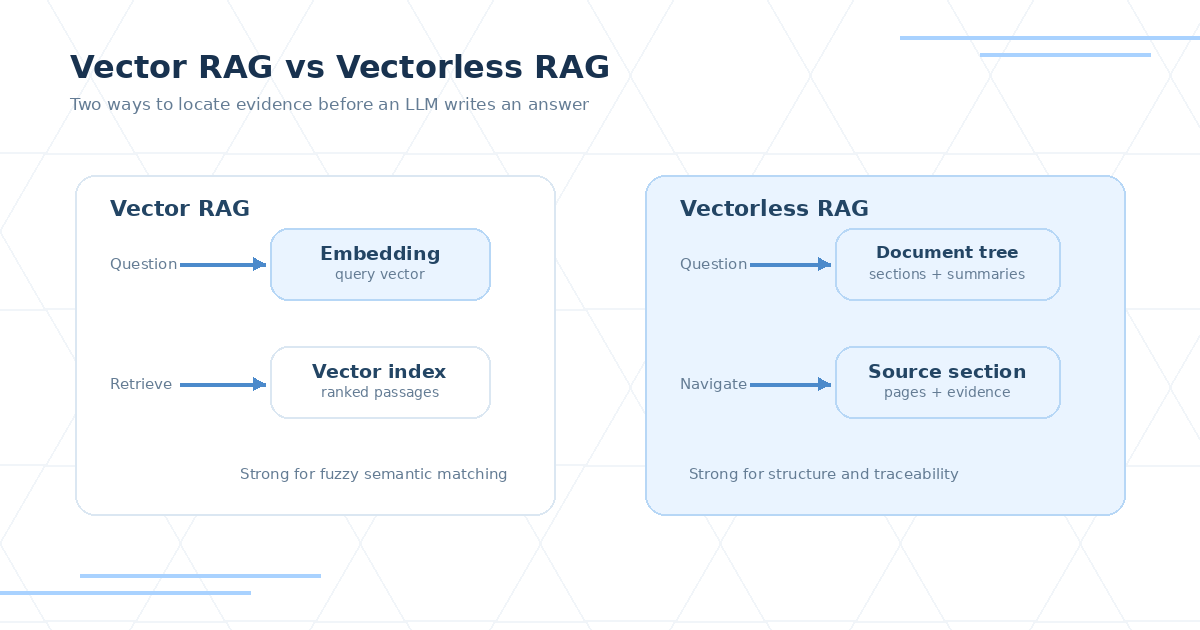
A typical vector pipeline parses documents, splits them into chunks, embeds those chunks, stores the embeddings, and embeds each incoming question. A nearest-neighbor search returns candidate chunks for the LLM. The method is powerful when people ask questions in different words from the source text: semantic similarity can find “parental leave” passages for a query about time off after a birth, even if the exact phrase differs.
But similarity is a proxy for relevance. A high-scoring chunk may omit a qualification in the next paragraph, a definition earlier in the document, or a table note that changes the answer. Fixed-size chunks can separate related content, while overlap can duplicate it. Document layout, hierarchy, and page references may be flattened or lost. Metadata filters and reranking help, but they add design and operational choices.
Vector retrieval can also be the wrong cost or complexity for a small, stable, well-organized set of long documents. If a question depends on navigating a report’s sections, asking an LLM to inspect a concise table of contents and then read the relevant pages may be a better fit. That does not make vectors obsolete; it means the retrieval mechanism should fit the shape of the evidence.
2. What “Vectorless RAG” means
In this article, vectorless RAG means a RAG workflow that does not rely on vector embeddings and a vector database as its primary retrieval mechanism. It still retrieves external information before generation. The index might be a hierarchical tree that mirrors document structure, a text or keyword index, a set of linked Wiki pages, or another explicit representation.
Think of a company’s 300-page travel policy. With vector search, the system might retrieve several text chunks that mention “hotel,” “approval,” or “receipt.” With a document-navigation approach, it can inspect a structured outline such as Expenses → Lodging → Approval limits, open the matching section, and read the full passage with its surrounding conditions. If the question is “What changed between the old and new policy?”, a Wiki could organize the two versions under a shared “Lodging approval” page and link each claim back to its source and date.
The outline or Wiki is an aid to finding evidence. It should not silently become the source of truth.
3. How vectorless retrieval works
A common document-first workflow has four stages:
Parse the source. Extract text, headings, page numbers, tables, and other useful structure from PDFs, HTML, or office files.
Build a navigable index. Represent the document as a hierarchy of sections and subsections, often with short summaries and page ranges.
Navigate for the query. An LLM reads the index, selects promising branches, and requests the underlying text for those sections. It can inspect more than one branch when the question needs comparison or several facts.
Answer from retrieved evidence. The model writes a response using the selected source passages, ideally with page or section citations.
The index may be compact, but query-time navigation can involve several LLM calls. A tree is therefore an index to guide reading, not magic memory that guarantees the right section will be found. Good systems set limits on traversal, keep source locations, and test retrieval as well as answer quality.
4. PageIndex and document-level navigation
PageIndex is an open-source example of a document-tree approach. Its project describes building a hierarchical index from long documents and using LLM reasoning to search that structure. Instead of retrieving fixed-size embedded chunks, the system navigates a tree to locate relevant sections and then consults the document itself.
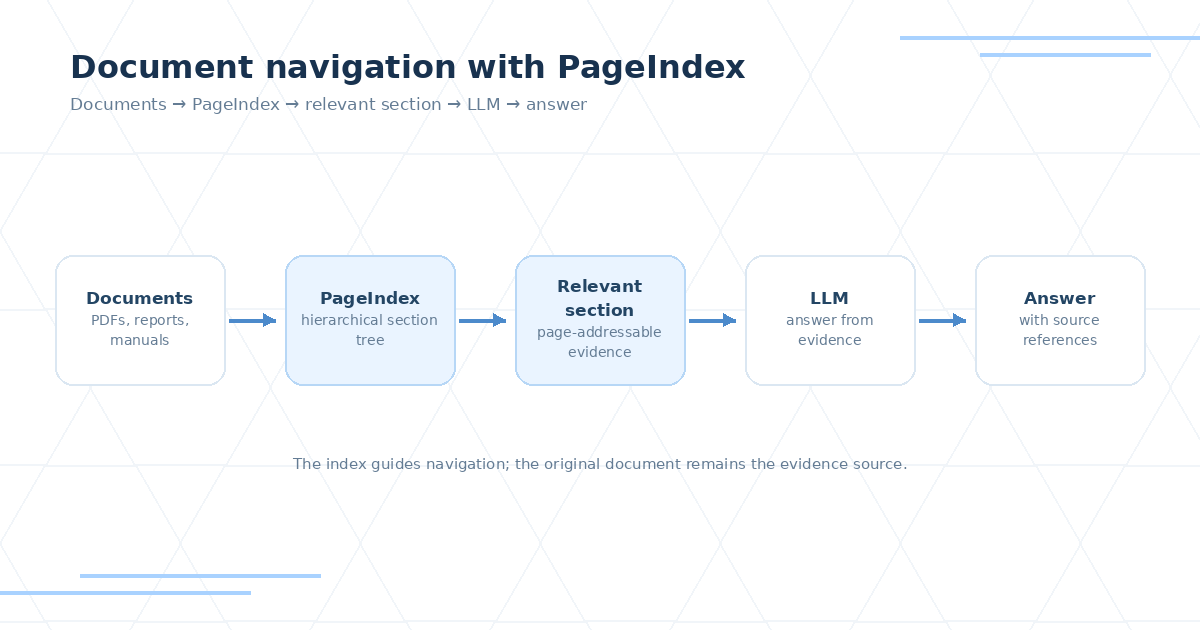
This is especially intuitive when source documents have meaningful organization: annual reports, technical manuals, contracts, policies, research papers, or regulatory filings. A table of contents and page-aware references give both the model and the reviewer a route back to the evidence. That can make it easier to explain where an answer came from.
There are trade-offs. The source must be parsed well enough for its structure to be useful. Poorly structured or scanned files may need OCR or preprocessing. An LLM must choose the right branches, and repeated reasoning steps can add latency and token cost. Very large collections also need a way to narrow down which document trees to inspect. Vendor benchmark claims are workload-specific; evaluate on your own documents and questions rather than treating a single score as a general guarantee.
5. Using an LLM-generated Wiki for knowledge retrieval
A second pattern compiles a document collection into a small, linked Wiki. An ingestion process extracts entities, concepts, rules, events, or decisions and creates pages such as Refund policy, Payment exceptions, and Approval limits. Pages link to one another and retain provenance: source file, page or section, version, and ideally the exact supporting passage.
At question time, the system searches or navigates the Wiki, retrieves relevant pages and their cited evidence, then asks the LLM to answer. The user-facing question can be phrased naturally, while the knowledge layer gives the model a more organized map than a pile of unrelated files.
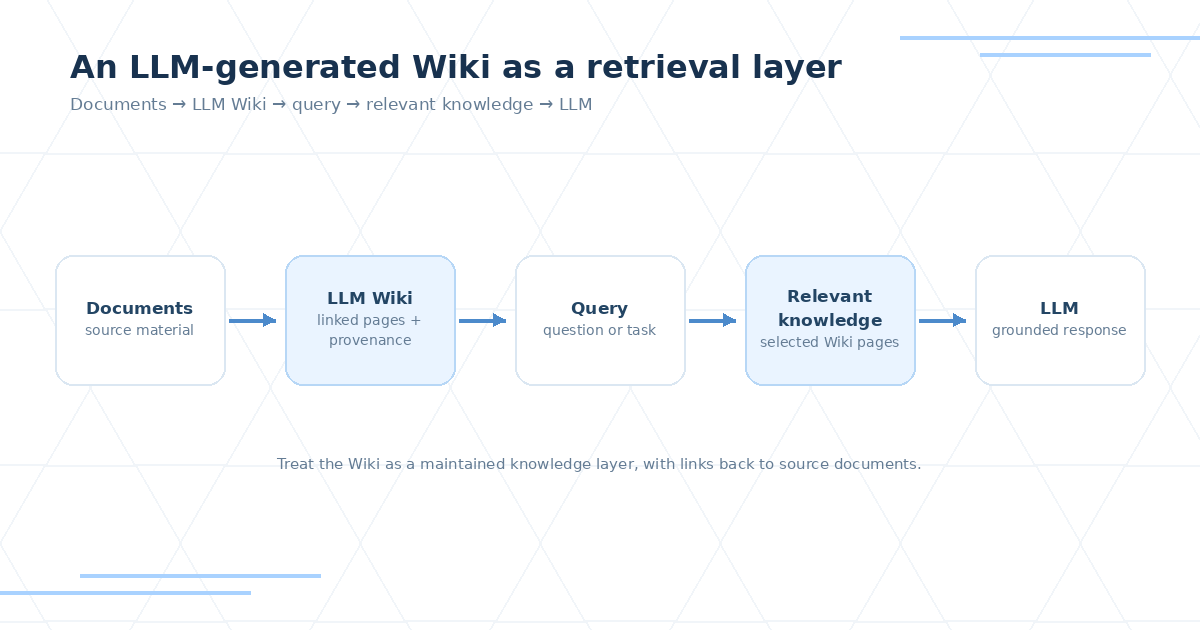
The Wiki can be generated once and revised as sources change, rather than asking the model to rediscover the same relationships on every query. But the compilation step can omit nuance, combine conflicting sources, or turn a tentative statement into a confident summary. Keep links to original documents, distinguish extracted facts from synthesis, track versions, and define how updates and deletions flow through the Wiki. For regulated or high-stakes information, retrieve and show the original evidence before relying on a summary.
6. A Wiki as a memory layer for AI systems
A well-maintained Wiki can act as an external, inspectable memory layer. It stores durable knowledge in a form that people and systems can navigate: concepts, decisions, entities, relationships, and links to evidence. An assistant can use it to preserve project context across sessions, connect a new question to earlier decisions, or give different agents a shared reference point.
This is different from treating the LLM’s conversation history as a complete memory. A Wiki can be edited, reviewed, versioned, and audited. It is also different from a model’s internal parameters: updating the Wiki does not require retraining the model. The memory is only as trustworthy as its update process, however. A stale Wiki is a stale answer waiting to happen. Use dates, ownership, source links, and refresh checks, and let the system say when evidence is missing or contradictory.
The distinction is not “database versus no database.” A vectorless system still needs somewhere to store documents and an index. The difference is how it selects evidence. And either architecture can use complementary tools such as BM25 keyword search, metadata filters, rerankers, or a graph.
7. Vector RAG vs. Vectorless RAG
| Dimension | Vector RAG | Vectorless RAG |
|---|---|---|
| Main retrieval signal | Embedding similarity, often combined with filters or reranking | Tree navigation, keyword search, links, or reasoning over a compiled knowledge layer |
| Best fit | Many short or irregular items; paraphrased queries; broad semantic recall | Long, structured documents; section-aware questions; traceable navigation |
| Indexing work | Chunking, embedding, vector storage, tuning | Parsing structure, building trees or Wiki pages, retaining provenance |
| Query work | Embed query, rank candidates, optionally rerank | Search or reason through the index, then fetch source sections or pages |
| Common failure | Similar-looking but incomplete or off-target chunks | Wrong branch, weak source structure, stale or lossy compiled knowledge |
| Evidence trail | Depends on chunk metadata and source offsets | Often natural to expose section, page, and source links |
| Scaling concern | Index size, update pipeline, filters, and vector-search operations | Candidate document selection, traversal cost, and maintaining compiled structures |
The distinction is not “database versus no database.” A vectorless system still needs somewhere to store documents and an index. The difference is how it selects evidence. And either architecture can use complementary tools such as BM25 keyword search, metadata filters, rerankers, or a graph.
8. Advantages and limitations of vectorless approaches
Potential advantages
Preserve document hierarchy and context instead of flattening everything into independent chunks.
Make page- or section-level citations a natural part of retrieval.
Avoid embedding and vector-database infrastructure when the corpus and workload do not need it.
Support multi-step questions that require following a document’s organization or links between concepts.
Offer a human-readable index or Wiki that can be reviewed and maintained.
Potential limitations
LLM-driven navigation may be slower or more expensive than a single optimized vector lookup, especially if it traverses many branches.
Retrieval quality depends on parsing, summaries, tree construction, and the model’s branch choices.
An LLM-generated Wiki is a derived artifact: it can omit, distort, or stale out the source material.
Unstructured, fast-changing, or extremely broad corpora may be difficult to organize and navigate without a broad first-stage search.
“No vector database” does not mean “no infrastructure,” “no indexing,” or “no retrieval failures.”
9. Hybrid strategies: when to combine both approaches
Hybrid retrieval is useful when the corpus is large and varied, but important documents also have internal structure. A practical design can use vector or lexical search to shortlist likely documents, then traverse a tree to locate the exact evidence. Or the system can query both a vector index and a Wiki, merge the candidate evidence, deduplicate it, and rerank against the question. In both cases, the final answer should use source passages rather than unsupported summaries.
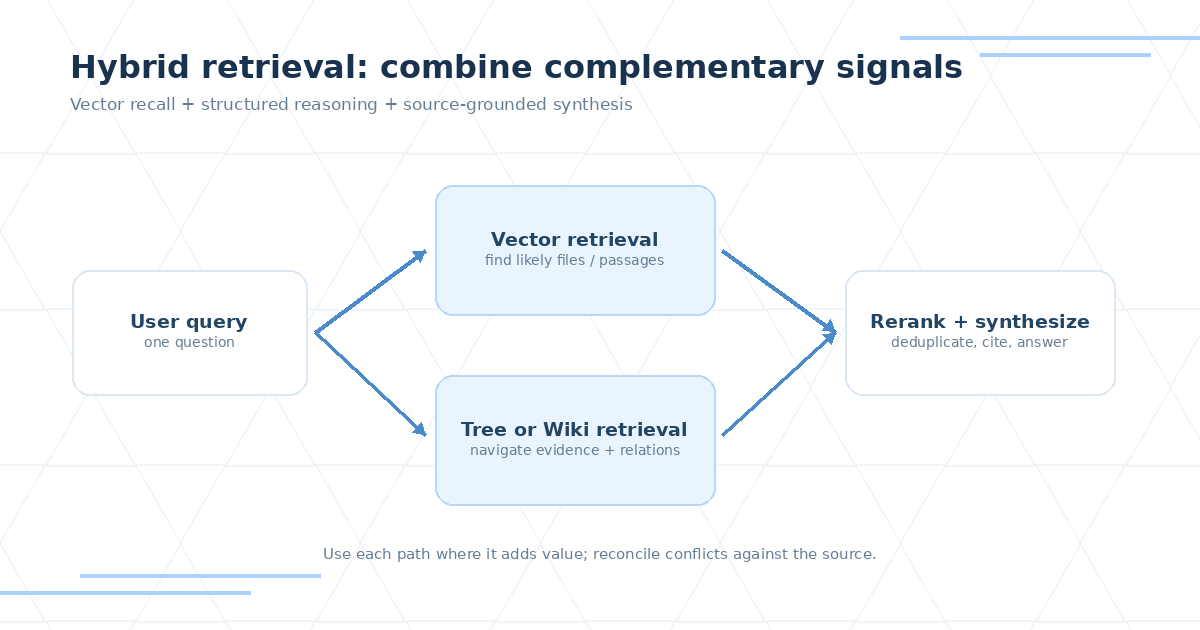
For example, in a financial research assistant, semantic search might find the relevant quarterly filings across thousands of files. A document tree can then guide the system to the “Liquidity and Capital Resources” section and its footnotes. A Wiki can add links to related company events or definitions. The hybrid design spends structured reasoning where it helps, while broad search prevents the system from having to inspect every document.
Hybrid systems need careful result fusion: two retrievers may find duplicate passages, disagree about versions, or return evidence with different levels of authority. Define source precedence, keep stable identifiers and citations, and measure whether the extra retrieval path improves answer quality enough to justify its latency and maintenance cost.
10. How to choose between Vector RAG and Vectorless RAG
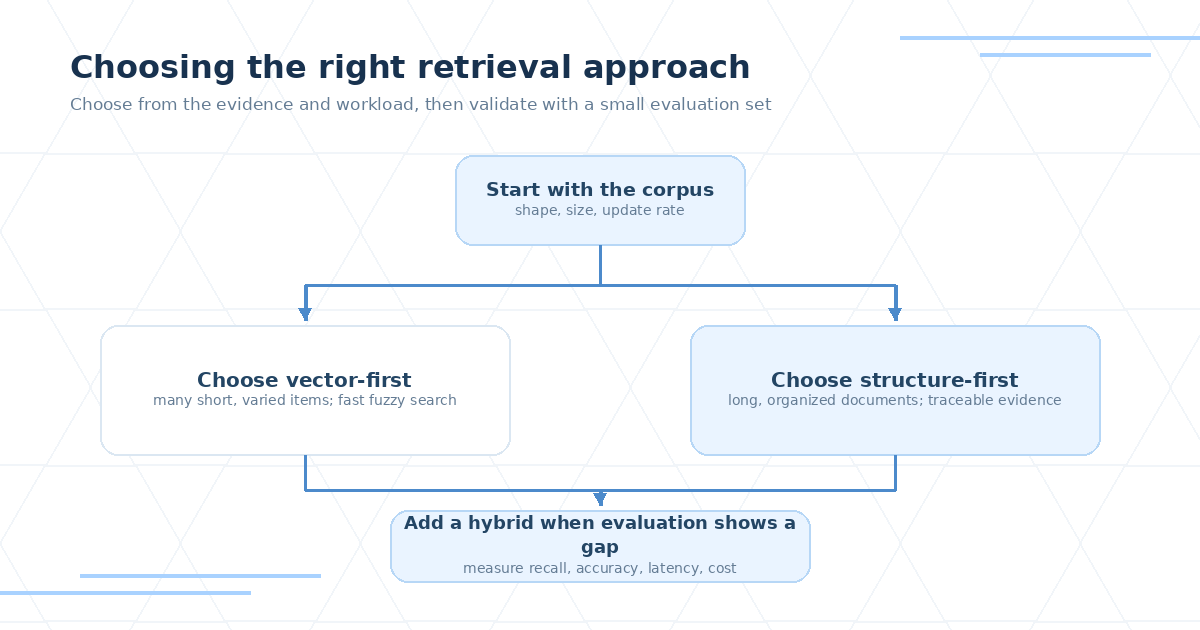
Use these practical guidelines as a starting point:
Choose vector-first when you have many varied documents or short records, users phrase questions unpredictably, and broad semantic recall matters. Add lexical search and metadata filters where exact terms or known attributes matter.
Choose structure-first when questions target long, well-organized documents and reviewers need section- or page-level evidence. Pilot a tree-navigation workflow on representative documents.
Choose a Wiki memory layer when the same concepts recur across sources or sessions, and a maintained, human-readable knowledge map has value. Keep source links, dates, and an update process.
Choose hybrid retrieval when the corpus is broad but documents contain important internal structure, or when evaluation shows that one retriever misses questions the other finds.
Run an evaluation before committing. Build a small set of representative questions with expected source passages. Measure retrieval recall, answer correctness, citation accuracy, latency, token use, update behavior, and operational complexity. Include hard cases: questions with exceptions, version conflicts, tables, and multi-document comparisons.
There is no universally superior retrieval architecture. The right choice depends on how your information is organized, how people ask questions, how current the answers must be, and what level of evidence you need to show. Vector databases remain a strong tool. Vectorless methods add another way to retrieve: navigate documents or organized knowledge the way a careful reader would.
Further reading
PageIndex on GitHub — an open-source document-tree retrieval project.
PageIndex documentation — project documentation and usage guides.
Retrieval-Augmented Generation for Knowledge-Intensive NLP Tasks — the original RAG research paper.
IBM Research: What is retrieval-augmented generation? — an accessible overview of grounding generation with external knowledge.
Editorial note: “Vectorless RAG” is used here as a broad label for approaches that retrieve without vector similarity as the primary mechanism. Specific projects use different indexes and workflows; verify current implementation details in their documentation.