Open Knowledge Format (OKF)
A better way to build knowledge for humans and AI Agents
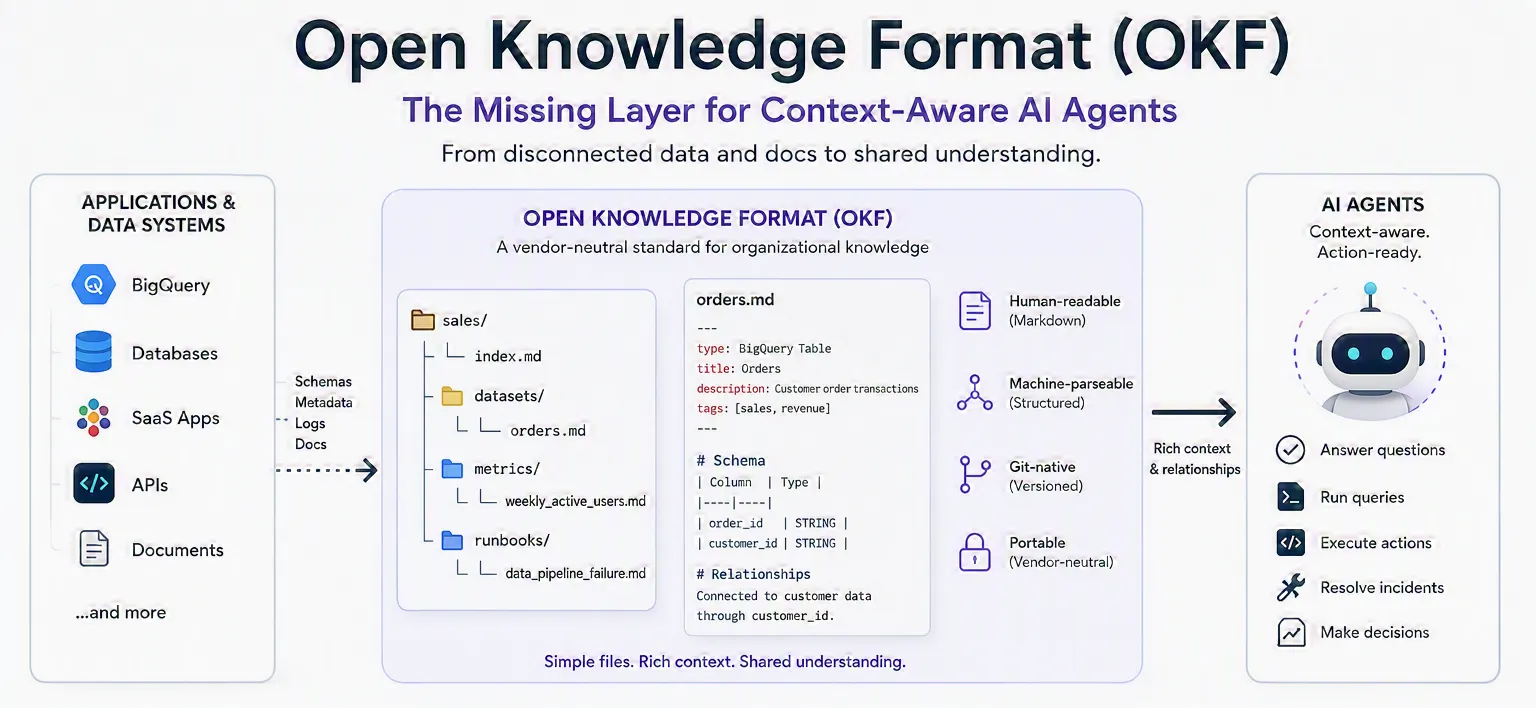
Imagine asking your company's AI assistant:
“What is our approved definition of net revenue, which payment tables should I use, and did the refund policy change last quarter?”
A conventional RAG assistant may retrieve a dashboard explanation, an outdated finance slide, and a Slack discussion containing the phrase net revenue. All three may be semantically relevant. But only one may represent the current, approved business definition.
This is the enterprise memory problem: finding related text is not the same as retrieving governed truth.
Google Cloud introduced the Open Knowledge Format (OKF) in June 2026 to help make enterprise knowledge portable and usable by both people and agents. OKF is not a new replacement for RAG. It addresses a different layer of the architecture: how knowledge is structured, connected, reviewed, and maintained.
In this article, we'll examine where baseline vector RAG struggles, what OKF actually standardizes, how to combine both approaches, and how to choose an architecture for your workload.
1. The Enterprise Memory Problem -and the Limits of Baseline Vector RAG
A common baseline RAG implementation uses the following pipeline:
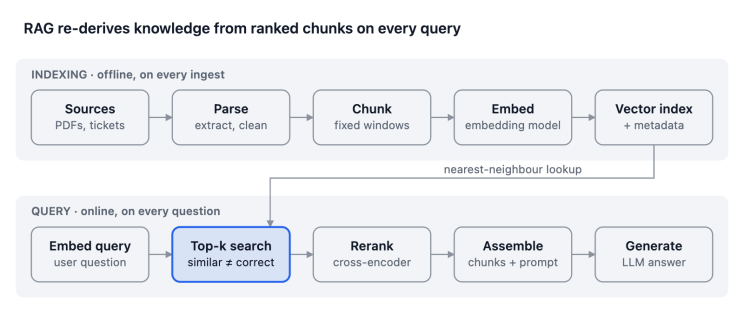
Why similarity is not authority
Now consider these enterprise questions:
- Metric definitions: “What exactly counts as active customer in our board report?”
- Compliance: “Which version of the KYC escalation rule applies to this case?”
- Data schemas: “Which payments table is approved, and how does it join to refunds?”
- Operations: “Which runbook is current for this incident severity?”
These are often known-knowns: somewhere in the organization there should be an approved, uniquely identifiable definition, rule, or procedure.
A top-k similarity result does not inherently know that a document is approved, superseded, restricted to another region, or owned by the finance team. It ranks relevance according to its search signals, not governance status unless governance is explicitly engineered into retrieval.
These problems are not proof that vector RAG is fundamentally broken. The bigger question is: why ask an LLM to reconstruct the same approved business knowledge from fragments every time?
2. What Is OKF? Open Knowledge Format Explained
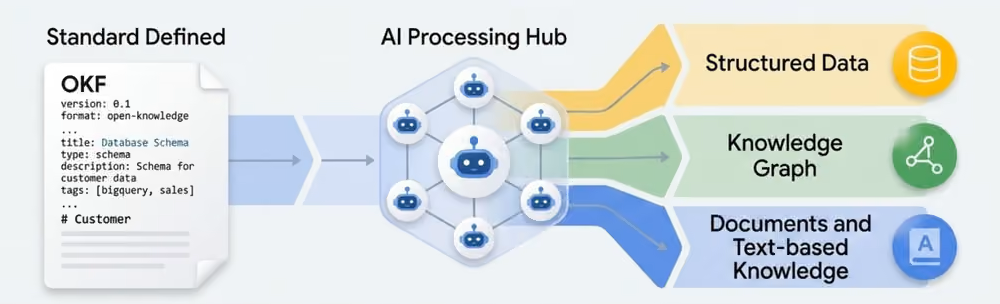
Open Knowledge Format (OKF) is an open, vendor-neutral specification for representing knowledge as a directory of Markdown files with YAML frontmatter. The files can be linked, reviewed in Git, read by humans, traversed by agents, and indexed by search systems.
Google Cloud's June 2026 introduction described an interoperable approach to the LLM wiki idea: instead of re-deriving business context from source systems in every interaction, maintain an evolving library of well-described concepts.
The new OKF v0.2, extends the basic format with optional metadata for source provenance, authoring and verification, lifecycle, freshness, and attested computations.
What an OKF knowledge bundle looks like
enterprise-knowledge/
├── index.md                          # Navigational entry point
├── metrics/
│   ├── index.md
│   └── net-revenue.md                 # Approved metric definition
├── schemas/
│   └── card-payments.md               # Table, keys, and dependencies
├── policies/
│   └── refund-and-chargeback.md      # Applicable policy and exceptions
└── runbooks/
    └── payment-reconciliation.md     # Operational procedure
The index.md files support progressive disclosure: an agent can first inspect what exists and open only the concepts it needs. Ordinary Markdown links express relationships between concepts. The linked documents form a graph-shaped knowledge base, although OKF does not require a graph database.
An agent can now look up the definition, follow the permitted join path to the schema, and check the policy that explains adjustments. Crucially, a reviewer can inspect and change the knowledge before the agent ever receives a user question.
What OKF is and what it isn't
OKF provides: a portable representation of curated knowledge, human-readable change history, explicit links, and optional provenance/freshness signals.
OKF does not provide by itself: a vector index, natural-language search, an agent runtime, access-control enforcement, guaranteed correctness, automatic synchronization, or a substitute for your data warehouse and transactional systems.
3. Architectural Clarification: OKF vs. RAG Is a Layer Separation
Calling this an “OKF vs. RAG” comparison is useful for discussion - but architecturally, the two solve different problems.
| Dimension | OKF | RAG |
|---|---|---|
| Primary purpose | Organize and distribute knowledge | Retrieve evidence and augment generation |
| Architectural layer | Knowledge authoring, representation, and governance | Query-time retrieval and orchestration |
| Typical artifact | Linked Markdown concepts with YAML metadata | Retriever, indexes, candidate passages, context assembly |
| Best fit | Canonical definitions, schemas, policies, playbooks | Large, unstructured, evolving, or exploratory corpora |
| Retrieval method | Not prescribed: direct lookup, navigation, or any index | Vector, keyword, hybrid, graph, SQL/tools, etc. |
| Human review | Git/code review is a natural fit | Depends on source and retrieval governance |
| Updates | Edit/validate the relevant knowledge concepts | Refresh source/indexes as required by the retriever |
| Main limitation | Curation and coverage cost; lookup at scale needs tooling | Relevance doesn't automatically establish authority |
| Can work alone? | Yes, for bounded, navigable knowledge | Yes, when curated OKF-style content is unnecessary |
Also, OKF content can be indexed by RAG. That is one of the most useful hybrid designs: RAG retrieves from well-governed concepts rather than only from raw, fragmented documents.
4. Designing the Hybrid Enterprise AI Architecture
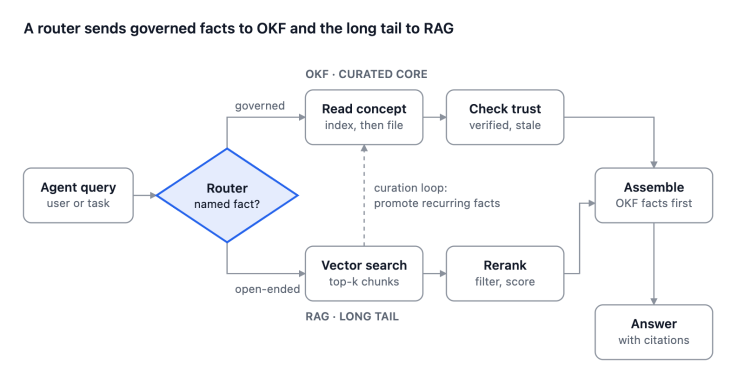
The most useful enterprise architecture often has three cooperating stages: upfront curation, runtime retrieval, and a query router that selects the right evidence path.
A router may use deterministic rules, a small model, or a combination. It classifies the user's intent and emits an evidence plan, not a free-form guess about which information is true.
This is an illustrative decision policy, not production-ready code. In production, add tenant scoping at every source, bounded tool calls, effective-date logic, observability, error handling, evaluation, and deterministic checks for regulated workflows.
End-to-end example: fintech revenue assistant
Question: “What was net revenue for EU card payments last month, and which chargeback adjustment rule applies?”
- The router identifies a canonical definition, live calculation, and policy lookup.
- OKF supplies the approved metric definition, applicable product scope, and links to the payment schema and chargeback policy.
- The agent checks authority, effective dates, and caller permissions. Conflicting or stale concepts cause escalation rather than silent selection.
- An authorized SQL service computes the number for the requested period, using approved calculation logic. If available, deterministic attestation checks the executed computation and the result.
- RAG optionally retrieves supporting change notes or exceptions from a larger document collection.
- The answer provides the value, time window, policy version, source links, and any uncertainty. If required evidence is missing, it abstains or requests review.
The result is not “a smarter vector database.” It is a system that knows the difference between a definition, supporting evidence, and a fresh computation.
5. Where Each Pattern Makes Sense: Real-World Use Cases
| Industry / workflow | Recommended starting point | Why |
|---|---|---|
| Fintech — approved KPI definitions and payment schemas | OKF-first; hybrid for investigation | A canonical metric or join path should be explicitly reviewed; historical cases still need discovery. |
| Banking — policy assistant with frequent regulatory updates | Hybrid | Rule identity, jurisdiction, and effective dates must be governed, while supporting memos and correspondence can be searched. |
| Healthcare — approved protocols and large literature collections | Hybrid with clinical oversight | Protocols need ownership and versioning; literature discovery is broader. Neither approach substitutes for clinical validation. |
| Software engineering — API contracts and runbooks | OKF-first | Teams benefit from direct, versioned concepts linked to code and services; add search for tickets and postmortems. |
| Enterprise support — millions of tickets and manuals | RAG-first; curate repeatable resolutions into OKF | Discovery dominates initially, while recurring answers can mature into approved knowledge. |
| Legal operations — contract and case discovery | RAG-first or hybrid | Search is essential for broad corpora; approved templates and internal decision policies can be curated. |
| Data analytics — natural-language-to-SQL | Hybrid with live SQL | OKF defines metrics and permitted joins; retrieval locates context; a governed query engine computes current numbers. |
The distinction is usually not industry A versus industry B. It is question type, knowledge stability, and consequence of error.
6. Decision Framework: RAG-Only, OKF-Only, or Hybrid?
Quick selection matrix
| Criterion | RAG-only | OKF-only | Hybrid |
|---|---|---|---|
| Broad fuzzy document discovery | Strong | Limited without extra search | Strong |
| Approved fact / definition lookup | Possible with governance | Strong | Strong |
| Multi-hop across canonical + raw sources | More orchestration needed | Limited to known linked knowledge | Strong |
| Dynamic enterprise corpus | Strong with refresh pipeline | Curation can become a bottleneck | Strong with both pipelines |
| Upfront knowledge curation | Low–medium | High | High for critical knowledge |
| Operational simplicity | Medium | High for small bundles | Lower |
| Guaranteed factual answers | No | No | No |
Decision shortcut: If you need to find what exists, start with RAG. If you need to state what the organization has approved, start with OKF. If you must do both in a single answer, build a hybrid—and test whether the improvement justifies the extra complexity.
7. A Practical Implementation Roadmap
You do not need to rebuild your enterprise search stack to adopt OKF. A small, measurable pilot is more useful than a grand rewrite.
Phase 1 - Establish a strong RAG baseline
Deliverable: an evaluation harness and a baseline you can challenge.
Phase 2 - Curate the first OKF bundle
Deliverable: a compact, Git-reviewed knowledge bundle.
Phase 3 - Add direct lookup and intent routing
Deliverable: a router with logged evidence decisions and an abstention path.
Phase 4 - Introduce graph and live-data tools only where justified
Deliverable: a constrained multi-hop enterprise assistant.
Phase 5 - Run an A/B/C evaluation and operationalize
Deliverable: evidence-based rollout criteria rather than architecture-by-hype.
Suggested minimal technology stack
A vendor-neutral implementation might use Git + Markdown + YAML for OKF, a small CI validation pipeline, Python/FastAPI for an authenticated lookup/router service, your current vector + keyword search for RAG, optional graph navigation, and an existing governed SQL/API layer for live values. Keep the model provider and search platform replaceable.
If you already run RAG in production, add a curated OKF source to it before introducing a new graph database. That often gives you the cleanest way to test whether better knowledge inputs improve the answers.
8. Trade-offs and Misconceptions Worth Calling Out
“OKF eliminates hallucinations.” No. A model can misinterpret even a verified file, and a verified file can later become wrong. OKF adds useful evidence and governance structure; it is not a mathematical correctness guarantee.
“Direct OKF lookup has zero latency.” No. It avoids some embedding/search work when the document is already known, but file reads, authorization, context assembly, network calls, and model inference still take time.
“RAG means cosine similarity.” Not necessarily. That describes one common baseline implementation. Modern RAG can use multiple retrievers, graph-based methods, reranking, and deterministic tools.
“OKF comes with a knowledge graph database.” No. Standard Markdown links can represent a navigable graph, but OKF does not prescribe graph storage or query infrastructure.
“Any file with verified is safe to trust.” Not automatically. Verification metadata must be meaningful, independently backed, current, and checked by the consumer. Enterprise authorization must be enforced outside the document format.
“Hybrid is always more accurate.” No. Bad routing can introduce irrelevant evidence; inconsistent synchronization can create new contradictions; more tool calls can increase cost and latency. Hybrid only earns its complexity when evaluation demonstrates value.
Final Takeaway
Enterprise AI systems do not fail only because models lack enough context. They also fail because the organization has not made the meaning, ownership, version, and relationships of its knowledge explicit.
RAG is a powerful way to discover evidence. OKF is a practical format for maintaining and exchanging curated business knowledge. They can coexist: a router can read an authoritative metric or policy from OKF, search supporting documents through RAG, traverse related concepts, and execute a governed live query when the user needs current numbers.
The goal should not be to replace embeddings with Markdown—or Markdown with embeddings. The goal should be to build an AI system that can answer three questions before it speaks:
- What relevant evidence exists?
- Which evidence is authoritative, current, and permitted for this user?
- Do we have enough verified information to answer—or should we abstain?
A useful rule of thumb: RAG helps an enterprise AI system find. OKF helps it remember what has been defined. The hybrid helps it reason with both, when correctly engineered.
Further reading and references
- Google Cloud — Introducing the Open Knowledge Format (June 12, 2026)
- Official GoogleCloudPlatform Open Knowledge Format repository
- Official OKF v0.2 specification
- EnterpriseRAG: Benchmarking LLM Instruction Adherence and Robustness (August 2026 preprint)
- EnterpriseRAG-Bench: A RAG Benchmark for Company Internal Knowledge (May 2026 preprint)
What is your biggest challenge in enterprise AI today: finding the right document, establishing which version is authoritative, or keeping knowledge current?
About the author
- AI Engineer
Comments
Join the discussionThe net-revenue example relies on several linked concepts agreeing, so I would make validation operate on the bundle as well as each Markdown file. A definition can be valid YAML while linking to a schema field that was renamed or to a policy outside its declared scope.
A CI check could resolve every internal link and validate the referenced field identifiers before publishing a bundle revision. Then the runtime records that bundle revision with its evidence plan. This makes the proposed Git review cover relationships that otherwise fail only when an agent tries to traverse them.
Great point! Completely agree that validating individual Markdown/YAML files isn't enough when business definitions depend on multiple interconnected artifacts.
Bundle-level validation is essential to catch broken references, schema changes, and policy-scope mismatches before deployment.
I particularly like the idea of versioning the entire knowledge bundle and recording that revision alongside the runtime evidence plan. It adds traceability and makes debugging much easier.
This is where OKF can move beyond structured knowledge representation toward a more reliable, CI/CD-driven enterprise knowledge lifecycle.
Thanks for adding this valuable perspective! 🙌